
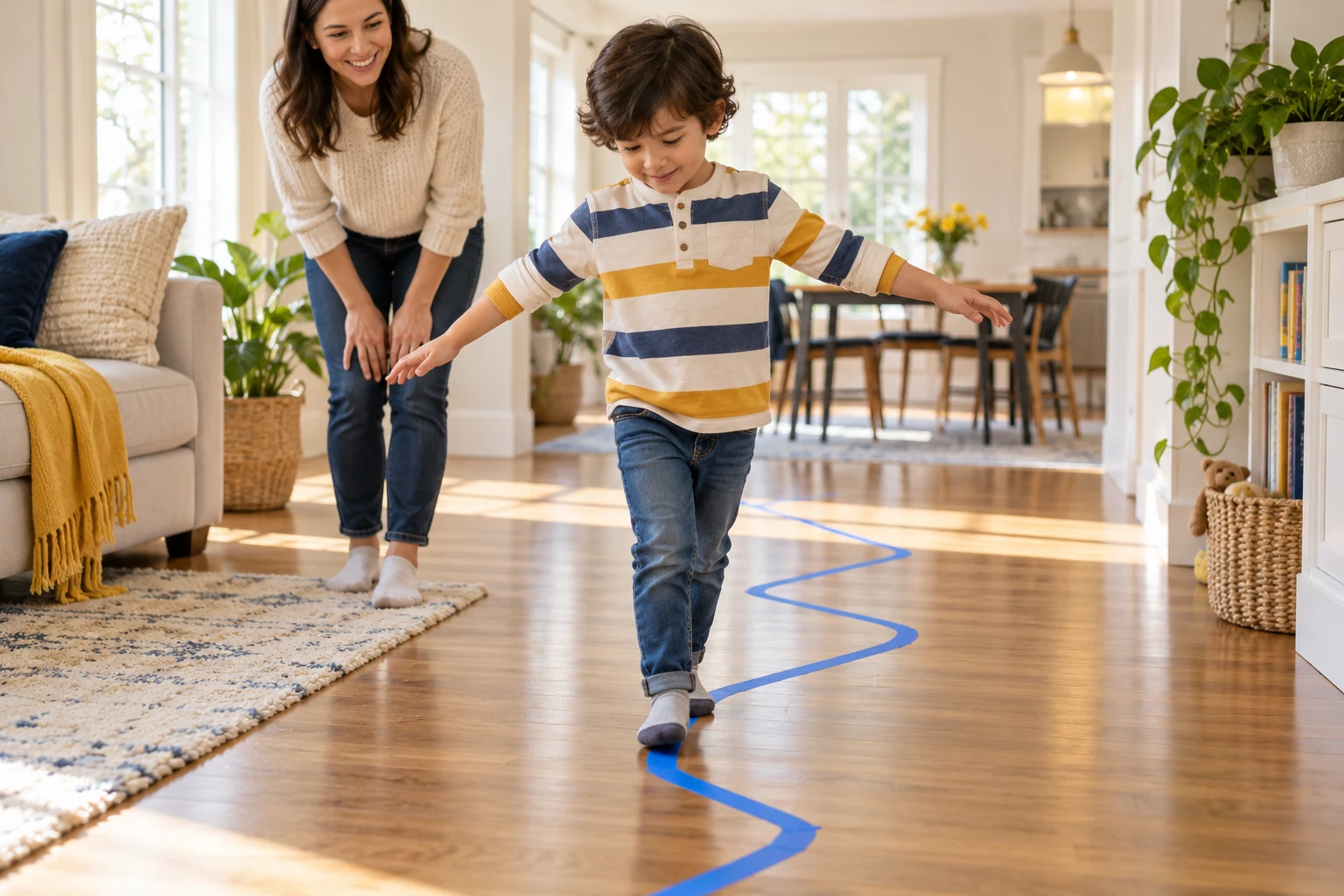
A strip of painter's tape can become a road, a riverbank, or a delivery route. You only need a clear patch of floor and a few minutes to make an indoor path your child can follow in different ways.
The path stays on the floor, so there is no raised beam to balance on. Keep the challenge playful and let your child step off whenever they want. Following a line is an invitation, not a rule that needs constant correction.
Set up a safe route
Test removable tape on a hidden area first and follow the tape and flooring instructions. Do not use tape on delicate surfaces if you are unsure whether it will lift the finish.
Choose a dry, nonslip floor away from stairs, doorways, sharp furniture, and busy walking routes. Make one short straight line first, pressing the tape down flat. Keep loose rugs and toys outside the play area. Bare feet or suitable nonslip footwear can be more practical than slippery socks.
Show your child where the path begins and ends. Walk beside it once together before adding a game.
Four ways to play
Follow the road
Walk slowly along the line with ordinary steps. Your child can step on it, beside it, or with one foot on each side. Choose the version that feels manageable. Later, add a gentle bend rather than making the path much longer.
Stop at the station
Place a large paper circle next to one point on the route. When your child reaches it, pause and wave to an imaginary passenger. Add only one station initially. This gives the walk a simple beginning, middle, and end.
Make a delivery
Carry a light soft toy along the path and place it in a basket at the finish. Walk back without racing. An older child might choose how to hold the toy, but do not stack objects so high that the route is hidden from view.
Copy the pace
One person leads with slow ordinary steps while the other follows at a comfortable distance. Swap leaders after one trip. Use “slow” and “usual pace” rather than encouraging running on a tight route.
Change one thing at a time
If the straight line feels easy, try a gentle zigzag or ask your child to pause at two stations. Avoid combining narrow steps, carrying, speed, and several directions all at once. It becomes hard to tell which part is enjoyable and which part is too much.
For a seated alternative, tape a short path to a suitable tabletop and move a toy car or fingertip along it. Your child can design bridges and stops with large blocks nearby.
When your child invents a different game
They may decide the path is a snake or use it to park toy cars. Follow that idea if the play remains safe. You can still use words such as start, finish, around, and beside without interrupting the story to teach a formal lesson.
Pack away while the tape is fresh
Remove the tape according to its instructions and check the floor for sticky spots or lifted edges. Store the basket and toy together if you want to repeat the game. Next time, let your child choose whether the route leads to a station, a shop, or a pretend picnic.