
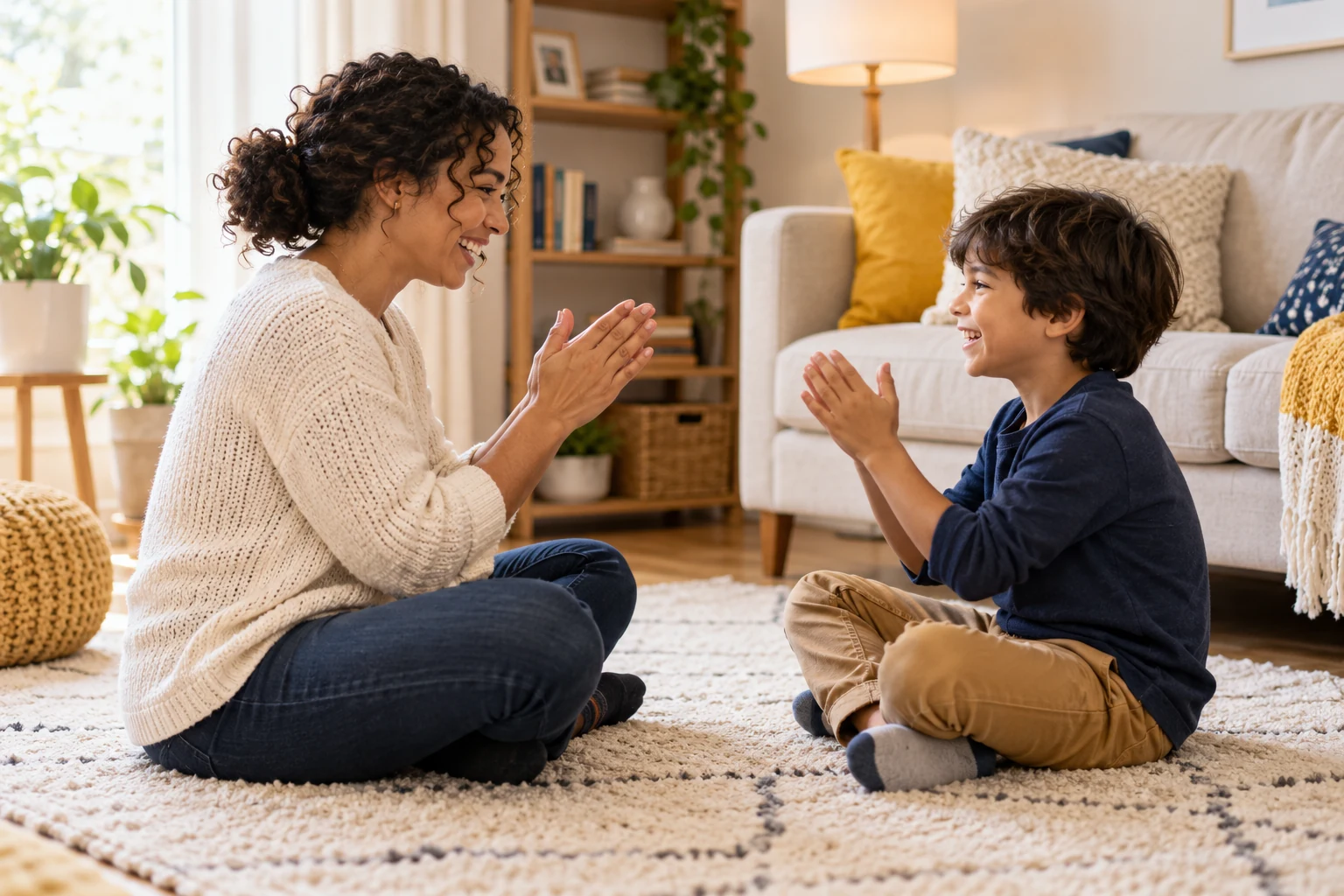
Two claps can start a whole game. Clap a short pattern, wait, and invite your child to make it back. There is nothing to print, buy, or set up, which makes this a useful idea for a short break at home.
Keep the activity about listening, copying, and taking turns. Your child does not need to keep a perfect beat, and a changed pattern can become an interesting new idea instead of a mistake.
Start with a pattern you can see
Sit facing each other so both pairs of hands are visible. Say, “My turn first, then your turn.” Clap twice slowly, lower your hands, and leave a clear pause.
If your child joins in immediately, try making the sounds together before returning to turn-taking. Some children enjoy shared clapping more than waiting to copy. Both are workable ways to begin.
Four patterns to explore
Two claps and a rest
Clap, clap, then pause with open hands. The silence is part of the pattern. Repeat it together before taking separate turns. Keep the rest long enough that it is easy to notice.
Clap and lap tap
Clap once, then gently tap your own thighs. Use a light touch and comfortable posture. Say the actions aloud at first if that helps: “clap, tap.” Remove the words only when they are no longer useful.
Slow and quick
Make two slow claps, then try two slightly quicker claps. Ask which version your child wants to lead. Avoid speeding up until the game becomes impossible to follow; the point is noticing a contrast.
Name rhythms
Say your child's name naturally and clap its syllables together. Try a family member's name or a favorite animal. There can be different ways to speak a word, so follow the pronunciation your family uses rather than insisting on one performance.
Let your child lead
After a few turns, become the copier. If your child makes a long pattern, ask them to show you the first two sounds again. This models asking for help without treating a complicated idea as a problem.
You might deliberately slow your own movements so your child can see each one clearly. Avoid pretending to fail constantly just to entertain them; genuine turn-taking often gives the game enough energy.
Make it quieter or simpler
Replace claps with finger movements, gentle taps on a cushion, or opening and closing hands. A child who dislikes sudden sounds can choose the quietest option. Touching another person's hands is unnecessary.
If two different actions are too much, use one repeated action. If a child cannot or prefers not to clap, a spoken sound, nod, or comfortable gesture can take its place. Choose a response they can make without strain.
Avoid turning it into a test
Notice whether your child enjoys the sounds and wants another turn. There is no need to score accuracy or claim that a rhythm game will improve grades. When attention moves elsewhere, end with one shared pattern and put the game aside.
Try it in an everyday pause
Use two quiet patterns while waiting for lunch or before opening a storybook. Because the setup is so small, the game can stay small too. A minute of back-and-forth play is a complete activity.