
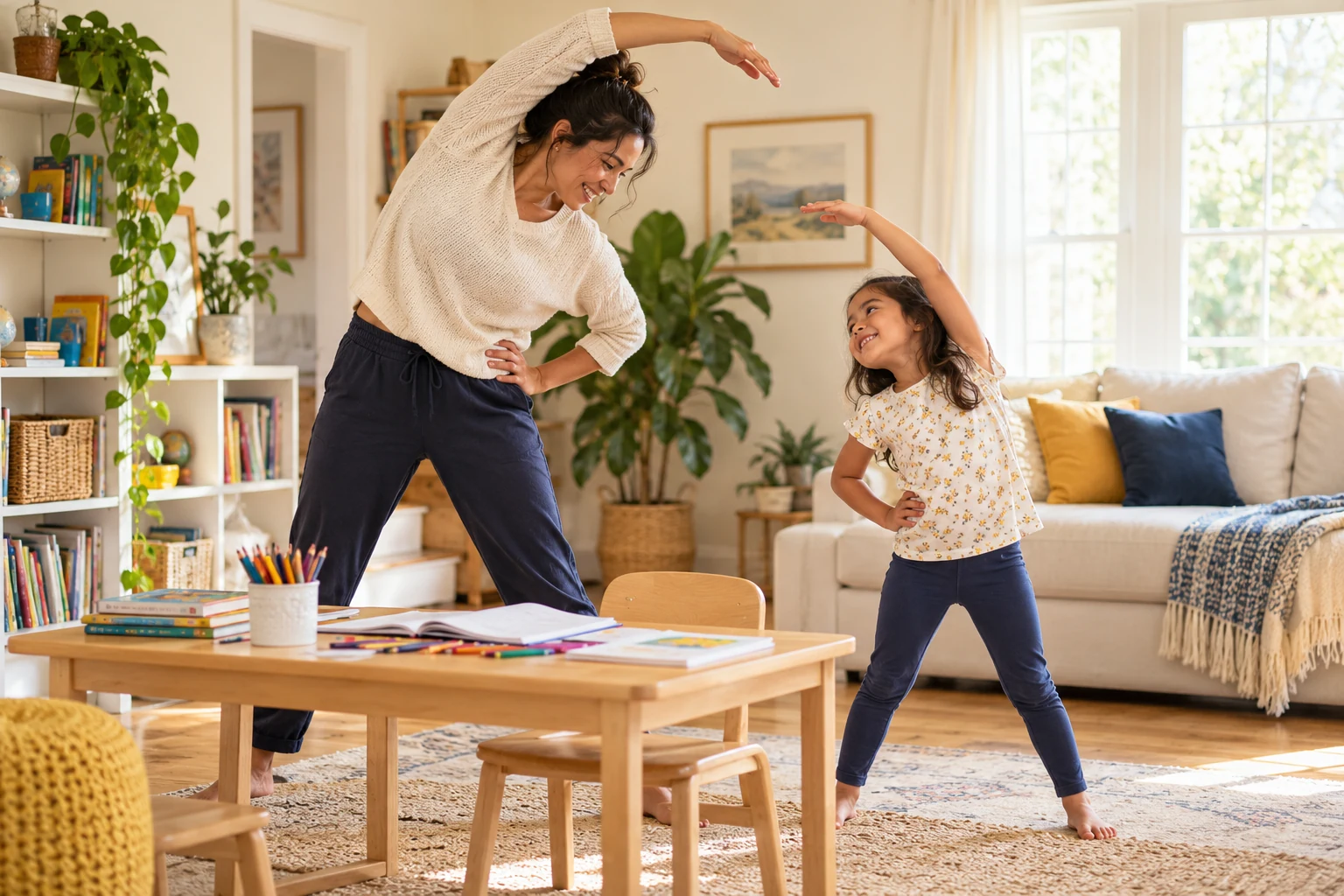
The pencil has stopped moving, the chair is rocking, and everyone could use a change of pace. You do not need a complicated activity to pause a lesson. A few minutes of comfortable movement can give your child something different to do before you decide what comes next.
This five-minute routine uses no equipment. It fits between reading and drawing, after a long car ride, or before tidying up. Treat the timings as a loose guide. A child who enjoys one movement can repeat it, and a child who has had enough can stop early.
Before you begin
Clear enough floor space for both of you to stretch without touching furniture. Choose a nonslip surface and comfortable clothing. Explain the whole plan in one sentence: “We will move together, choose a favorite move, and then look at our book again.”
Demonstrate beside your child. They do not need to know left from right or copy every detail. Offer seated versions from a stable chair if standing is uncomfortable or unsuitable.
Your five-minute routine
Minute 1: March and pause
Walk or march gently in place. After a few steps, say “pause” and become a statue. Start again when your child is ready. Keep knees at a comfortable height and avoid turning the game into a speed challenge.
Minute 2: Reach for imaginary clouds
Reach one hand upward, bring it down, and try the other hand. Next, stretch both arms out to the sides if space allows. Imagine touching soft clouds rather than trying to stretch as far as possible. Keep feet steady and movements small.
Minute 3: Copy my shape
Make three easy shapes: arms wide, hands on shoulders, and hands resting on knees. Let your child copy each one. Then swap roles. If your child invents a complicated pose, ask for a version you can both do comfortably.
Minute 4: Let your child choose
Offer two options, such as slow marching or gentle clapping. Give the chosen movement your full attention for a few rounds. A small choice keeps this part simple while allowing your child to lead.
Minute 5: Slow down together
Take a few easy steps, relax your arms, and sit or stand comfortably. Ask, “Would you like to start with the picture or the first sentence?” Make the next learning step clear and small.
If returning to the lesson is difficult
A movement break does not guarantee that a child will feel ready to work. Check whether the task is too long, unclear, or simply poorly timed. Hunger, tiredness, and needing help can still be present after a fun game.
You might read one paragraph together instead of asking for a full page. You might also decide that the lesson can wait. The break is useful information about how the day is going, not a test your child has passed or failed.
Make it your own
For a younger child, use just two movements and repeat them. For an older child, invite them to lead the sequence. If noise is an issue, replace clapping with silent hand shapes.
Stop any movement that causes discomfort, dizziness, or frustration. In our Brain Gym category, activities like this are everyday movement play. They are not medical treatment or a promise of better grades.
A small next step
Choose one natural pause in tomorrow's routine and try two minutes first. Keep the movements your child enjoys and leave the rest. A familiar, easy-to-repeat break is more useful than a routine that takes extra work to organize.