
Worksheets are one way to practice a skill, but they are not the only way to see what a child understands. Talking, building, sorting, drawing, and explaining can also make learning visible.
Choose the skill first, then find a hands-on way to explore it. If the goal is counting, count real objects. If the goal is retelling a story, give your child something to move or draw while they tell it.
1. Open a pretend shop
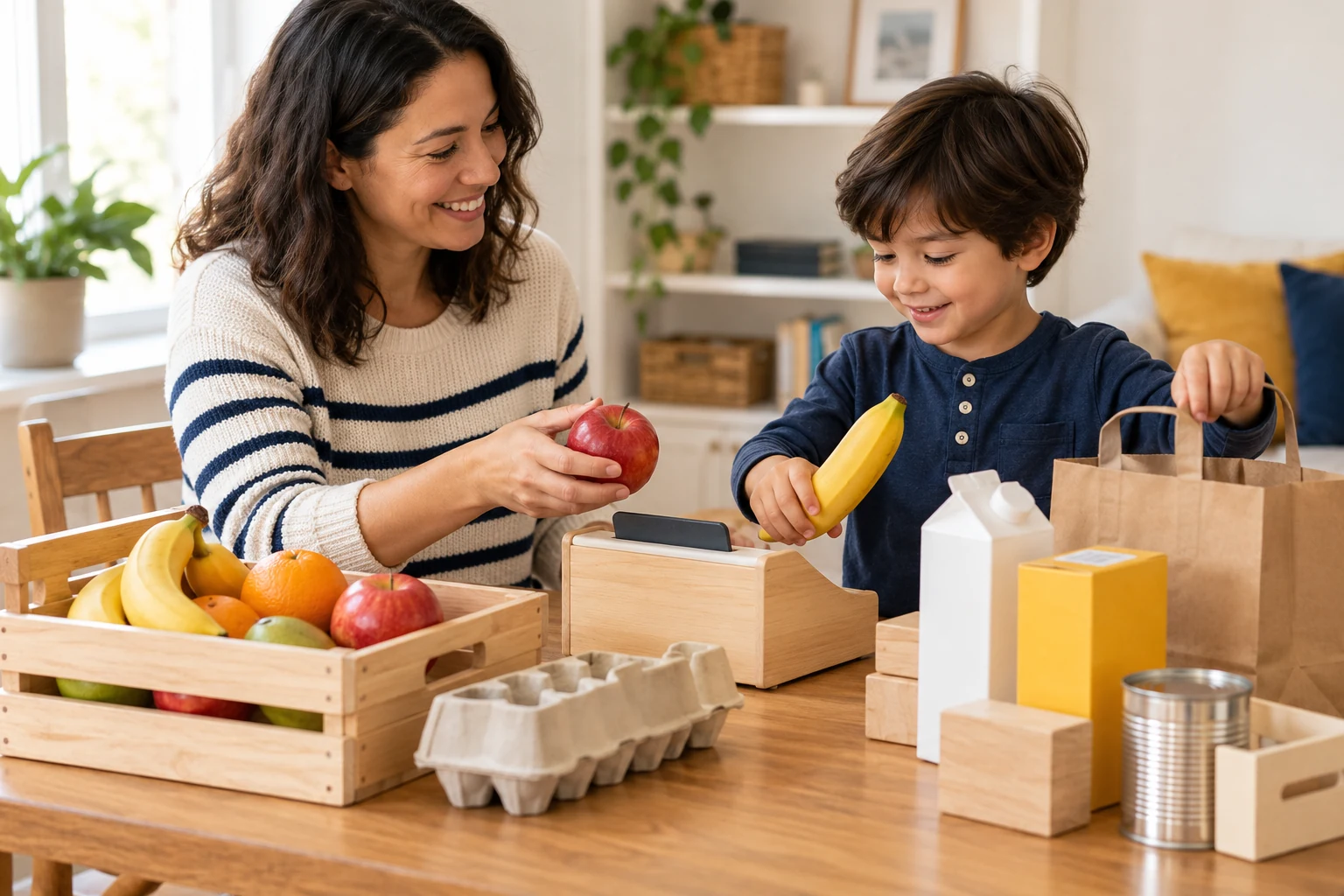
Arrange a few clean cartons, whole pieces of fruit, or large toys. Make a simple shopping list using pictures. Ask your child to collect two apples or choose one item for each family member.
Older children can write labels or use made-up prices and paper money. Keep the number work appropriate to their current understanding rather than turning the shop into a difficult calculation exercise.
2. Retell with three pictures
After a familiar story, fold paper into three sections. Invite a drawing for the beginning, middle, and end. Your child can talk while you write their words underneath.
Accept a different detail from the one you expected. Ask how the pictures connect instead of insisting on a memorized summary.
3. Measure things that matter
Use a ruler or a line of identical large blocks to compare a book, a toy, and a box. Place the measuring units end to end without gaps when comparing lengths.
Ask which object is longer and how your child checked. Measuring something they are building often gives the task a more natural purpose than measuring unrelated items.
4. Sort and explain
Offer a small collection of large, safe objects. Your child might sort by color, shape, material, or use. After one arrangement, ask whether there is another way to group the same items.
The explanation matters. Two different groupings can both make sense when the child can describe the rule.
5. Build from a spoken description
Use a few large blocks. Give one instruction at a time: “Put the long block beside the square one.” Swap roles so your child describes a structure for you to build.
This creates a reason to use positional words such as above, below, beside, and between. Keep the model small enough that the conversation stays enjoyable.
6. Write a useful list
Make a picnic list, a message for a family member, or labels for a pretend museum. A beginning writer can draw and dictate while an older child writes independently.
When writing serves a clear purpose, you can focus on one manageable teaching point. Correcting every letter at once may interrupt the reason for making the list.
7. Record a real observation
Watch a seed, examine a shadow, or compare two leaves. Ask your child to draw what they see and tell you one detail. Add the date so you can compare observations later.
Keep enough evidence to guide tomorrow
Save a photo of a model, a short note of what your child explained, or one drawing. You do not need to document every moment. Keep examples that help you decide what needs more practice and what is ready for a new challenge.
Hands-on learning still benefits from clear goals and appropriate instruction. Pick one idea for a skill you are already teaching, then notice whether the activity helps your child show their thinking.