
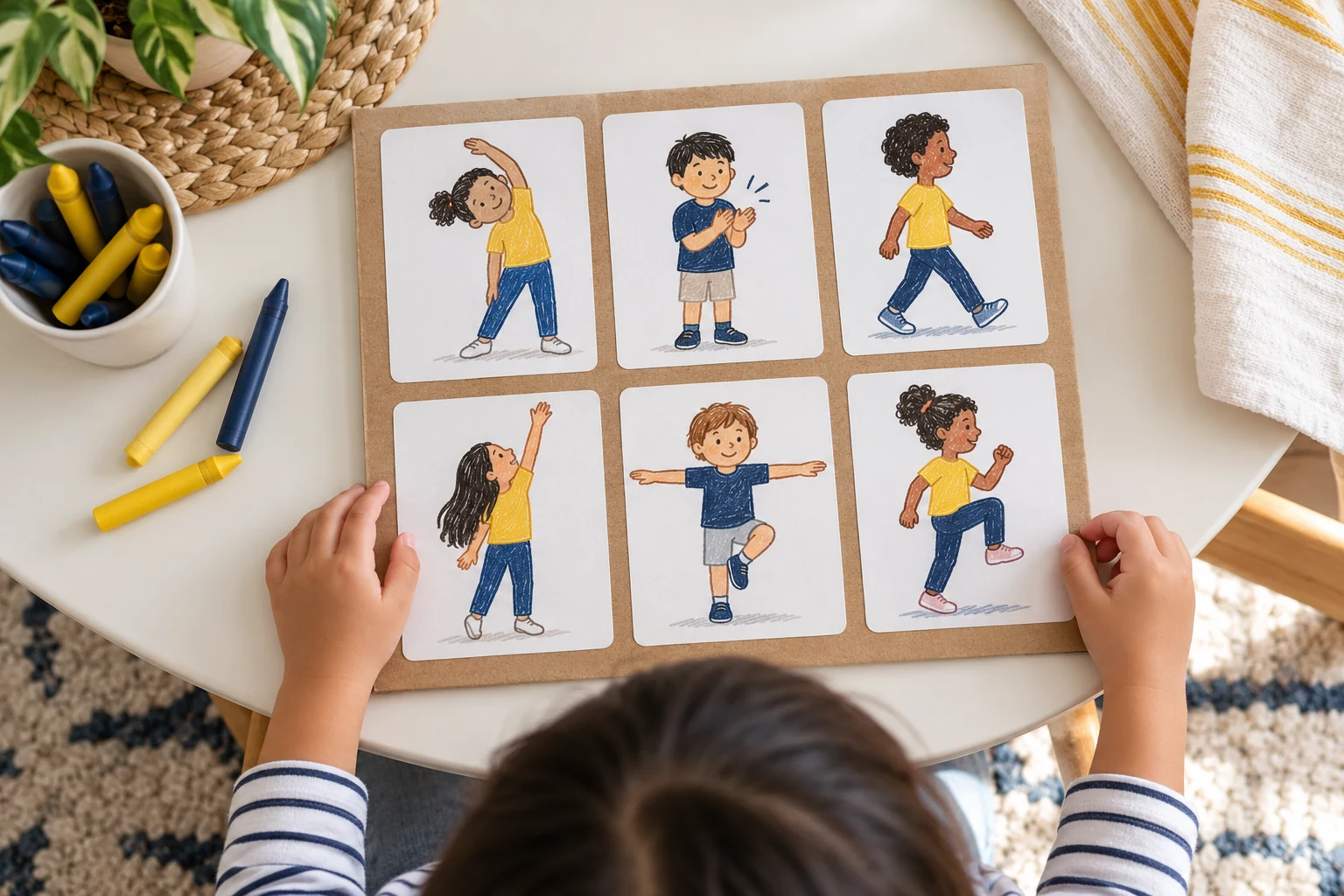
When a child needs a break, a long list of suggestions can be surprisingly unhelpful. A small movement choice board makes the options visible. Your child points to one picture, you try the activity together, and then you decide what comes next.
The board does not need printed graphics or a laminator. Simple drawings on paper are enough. Start with movements your child already knows so the pictures act as reminders rather than a new set of instructions.
Choose four to six familiar actions
Pick a mix of standing and seated choices. For example, use marching, gentle reaching, clapping, slow walking, opening hands like butterfly wings, and touching opposite knees while seated.
Choose only actions that are comfortable and suitable for your child. A board works best when every visible choice is actually available. Leave out jumping if the room is too small or if downstairs neighbors need quiet.
Make the cards
Cut or fold paper into large cards. Draw one clear action on each and add a short label if useful. A stick figure with arms reaching up can represent “reach.” A pair of hands can represent “clap.”
Show each card while doing its movement. Ask your child what they would call it. Their own name, such as “cloud hands,” may be easier to remember than an adult's exercise term.
Attach the cards to a sheet of paper or simply place them in a row. Keep small fasteners and detachable pieces away from children who mouth objects. Large paper cards laid on a table work without any fasteners.
Use the board for a short break
- Offer two available cards rather than the whole set at first.
- Let your child point, name, or otherwise indicate a choice.
- Do a few comfortable repetitions together.
- Ask whether to repeat, choose another card, or finish.
- Put the cards away and explain the next small step in the day.
You can say, “Would you like marching or butterfly hands?” Avoid presenting the choice as a demand to be cheerful or ready to work afterward.
Add a clear finish
A simple “finished” space helps separate choosing from continuing indefinitely. Your child can move a used card there after the activity. This is a visual reminder, not a rule that each card must be completed once.
If your child always chooses the same movement, that is fine. Familiarity may be exactly what they enjoy. You can occasionally show a new option without removing the favorite.
Solve common sticking points
If the pictures are confusing, replace them with clearer drawings and practice when nobody is rushed. If six cards lead to indecision, use two. If the board becomes another source of negotiation, put it away and offer a simple shared walk instead.
The board cannot tell you why a child is uncomfortable, tired, or reluctant to begin a task. Treat it as one practical tool, not the answer to every difficult transition.
Keep it easy to reach
Store the cards beside the learning materials or in a small envelope. Review them occasionally as your child's preferences change. The useful board is the one with a few recognizable choices that your family can use without extra preparation.