
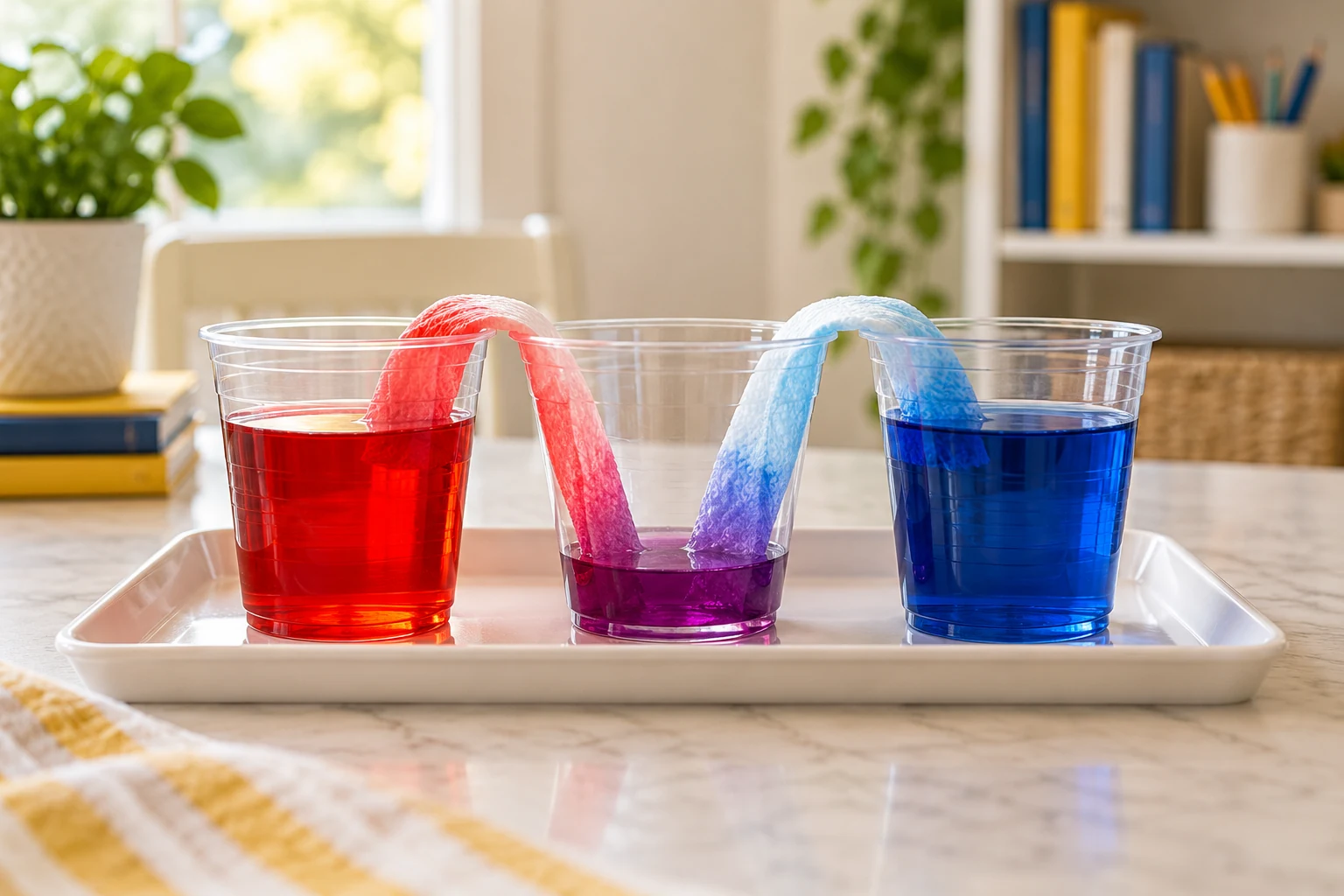
Water usually seems to need pouring to move from one cup to another. This activity gives your child a different way to watch it travel. A paper towel becomes a bridge, and color helps make the movement visible.
Plan a short setup followed by occasional observations. This is not an instant experiment, so choose a place where the cups can stay undisturbed while your family does something else.
Gather the materials
Use three matching clear plastic cups, water, two absorbent paper-towel strips, red and blue food coloring, and a tray. An adult should handle the coloring, which can stain. The water is for observing, not drinking.
Set up the three cups
Put the cups in a row on the tray. Half-fill the two outside cups with equal amounts of water. Leave the middle one empty. Stir a little red coloring into one outside cup and blue into the other.
Fold each towel strip into a narrow bridge. Place one end in an outside cup and the other in the middle cup. Repeat on the opposite side. The towel ends must reach the water, and the bridges should not be much taller than the cup rims.
Watch in stages
Look at the towel ends first. Return after about 15 to 20 minutes, then later in the day. Water may take hours to collect clearly in the middle cup. Keep an adult responsible for the setup and empty the cups when finished.
Explain what is happening
Water enters tiny spaces between the paper fibers through capillary action. Attraction between water and the fibers, together with attraction between water molecules, helps it move through the towel. Gravity assists the downward journey. When the colored water meets, the dyes mix. See Science Buddies' explanation of walking water.
Turn waiting into observation
Give your child a folded page with three spaces. In the first, draw the setup before anything changes. In the next, draw the wet part of the towel. In the last, draw whatever is visible later.
For a child who does not want to draw, write down their words: “The red has gone around the bend.” Keep observations separate from guesses. “I think the middle cup will turn purple” is a prediction; “There is purple water at the bottom” describes something seen.
If the change is hard to see
Look at the practical setup together. Is each end still touching the water? Has a strip fallen out? Are the cups close enough for the bridge to stay in place? Adjust one issue and allow more time.
Do not promise an exact finishing time or a particular shade of purple. Paper, dye, water amounts, and room conditions vary. An unexpected result is a reason to inspect what happened, not to hide the experiment from your child.
Choose one follow-up question
Ask your child which part they would like to investigate again. Perhaps they want to compare two towel brands using otherwise matching setups. Help them change just that feature so the comparison means something.
Finish by looking back at the first drawing. The useful question is not simply “Did it work?” Ask, “What can we see now that we could not see at the start?”