
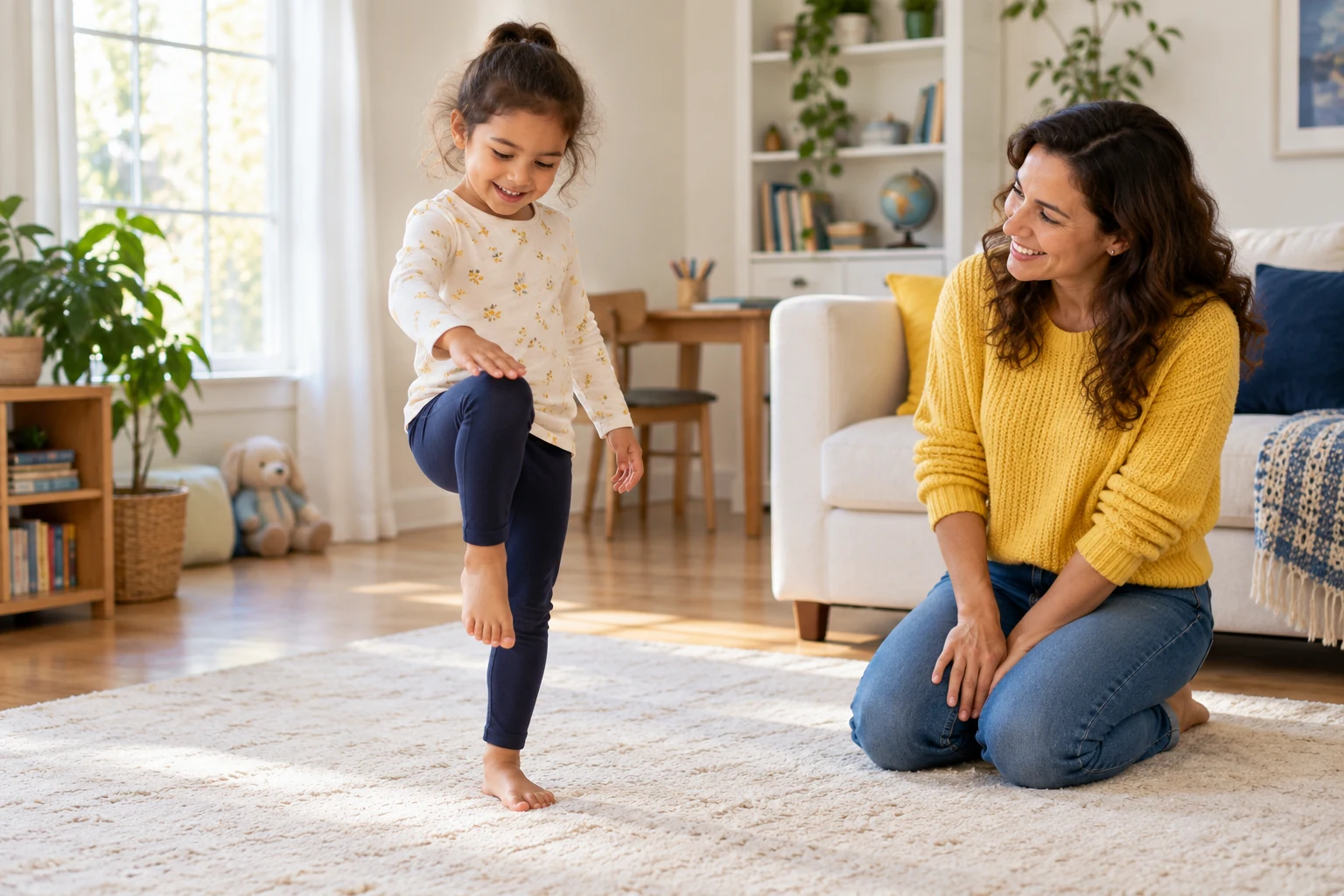
Cross-body movements happen when a hand or foot moves across the middle of the body. Reaching for something on the opposite side of a table is an everyday example. You can explore similar movements through short games without turning your living room into an exercise class.
The four ideas below work well as a playful pause with a parent. Choose one to begin with. Your child does not need to complete every game or get the pattern right on the first attempt.
1. Opposite-knee taps
Stand beside your child with enough room to move. Slowly lift one knee and touch it with the opposite hand, then lower the leg. Try the other side. Keep the movement comfortable and the pace unhurried.
If balancing is difficult, sit on a stable chair with both feet supported. Reach one hand toward the opposite knee, return it to your lap, and swap hands. Touching the knee is optional; reaching in its direction is enough.
Avoid rapid counting at the start. Say “reach, return, swap” so there is time to see each part. If your child uses the same-side hand, demonstrate again without making the moment feel like a correction drill.
2. Deliver the pretend mail
Place a small stack of large paper envelopes on one side of the table and a tray on the other. Ask your child to move one envelope at a time across the table using one hand. After a few deliveries, move the stack to the other side and offer the other hand a turn.
Keep objects within easy reach. The aim is a small comfortable reach across the body, not twisting far or leaning off the chair. You can draw animals on the envelopes and pretend each delivery goes to a different house.
3. Pick imaginary apples
Pretend there is a branch slightly above one shoulder and a basket near the opposite hip. Reach toward an imaginary apple, then bring it across to the basket. After a few apples, switch the tree and basket to the other side.
Let your child choose the fruit, its color, and whether the basket is nearly full. Keep shoulders relaxed and avoid reaching higher than feels comfortable. This game can also be done while seated.
4. Pass the soft toy
Sit side by side on the floor or in stable chairs. Pass a soft toy between you, varying whether it arrives on the left or right. Ask your child to place it in a basket across their body before picking it up again.
Use a large, light toy and put the basket close by. There is no need to add tossing, eyes-closed play, or a time limit. Those changes make it a different and less predictable task.
Keep the instructions small
Show one movement, try it together, and pause. “Touch this knee” may be more useful than a long explanation about left and right. If the game gets confusing, simplify it to ordinary reaching and passing.
These activities offer practice with a movement pattern. They do not diagnose coordination difficulties or guarantee changes in attention or learning. Stop if a movement hurts or your child wants to stop.
Make a two-minute game
Pick one favorite movement and build a tiny story around it. Deliver three letters or pick five imaginary apples, then finish. A short shared game leaves room for another turn on a different day.