
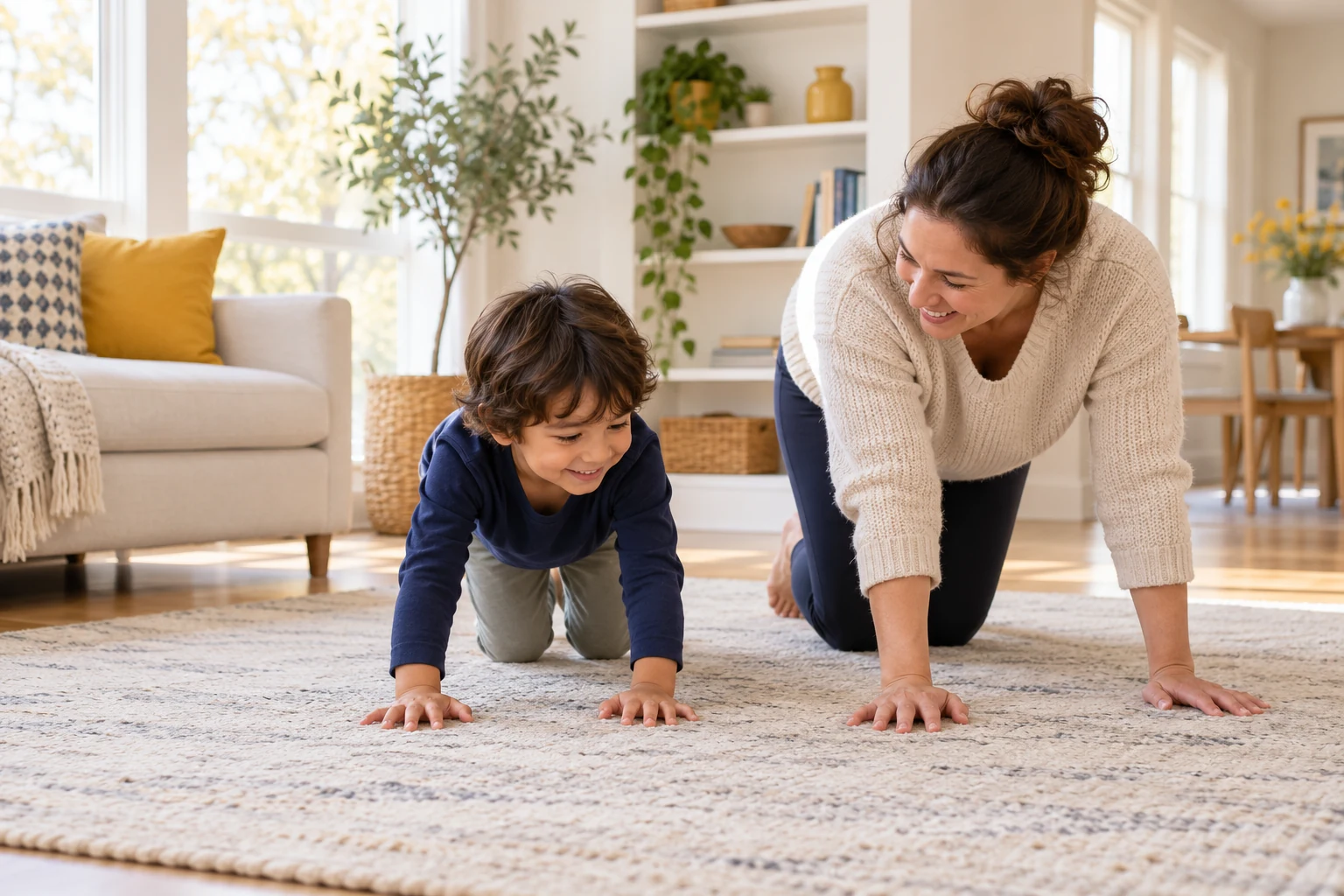
“Can you move like a very sleepy bear?” is often all the invitation a child needs to start pretend play. Animal movements give a short indoor break a story, and the story can be as silly or as quiet as you like.
You do not need a long obstacle course. Pick two or three comfortable movements, use a clear floor, and travel only a few steps at a time. The animals are inspiration rather than positions a child must copy exactly.
Prepare a small space
Move toys and sharp-edged furniture out of the route. Use a stable, nonslip surface and check that the child has enough room to turn. Avoid racing, furniture climbing, and jumping from objects.
Show the movement first and ask whether your child wants to try it. A standing or seated version is always an option. Stop if the movement puts uncomfortable pressure on hands, knees, or other joints.
1. The slow bear
On a comfortable floor surface, move on hands and knees for a few small steps. Imagine the bear is walking quietly past sleeping animals. There is no need to lift the knees into a demanding exercise position.
For a standing version, walk slowly while making small pretend bear paws with your hands. For a seated version, alternate gently moving the hands forward as if the paws are walking through the air.
2. The tall giraffe
Stand comfortably and reach one arm upward, then lower it. Imagine the giraffe is choosing a leaf from a low branch. Keep both feet on the floor rather than balancing on tiptoe.
Change the story by placing pretend branches slightly to either side. Keep every reach within a comfortable range. A seated giraffe can make the same gentle arm movements.
3. The careful penguin
Take small ordinary steps with arms resting near the sides. Pretend to carry a delicate fish to a nest. Do not ask your child to lock their knees or turn their feet into an awkward position.
Mark a nearby nest with a cushion outside the walking route. Reach it, pause, and decide whether the penguin wants another trip.
4. The quiet butterfly
Stand or sit and slowly open the arms like wings. Close them comfortably and repeat. The butterfly can be tiny, tired, or moving very carefully through a garden.
This is a useful final movement because it can be done slowly without crossing the room. Let your child choose where the butterfly lands.
Build a tiny animal story
Link just two animals together: the bear visits a tree, and the butterfly flies down to meet it. Give your child time to add an idea. If they want to become a different animal, find a comfortable movement together rather than searching for the “correct” version.
When everyone gets too excited
Shorten the route and switch to seated animals. You can also finish the story: “The animals are home, and the game is done.” Avoid trying to calm a busy room by adding increasingly difficult movement rules.
End with one choice
Ask which animal should appear next time. That is enough reflection for this kind of play. Animal movement games offer imagination and a change of position; they are not a treatment or a guarantee that a child will settle immediately afterward.