
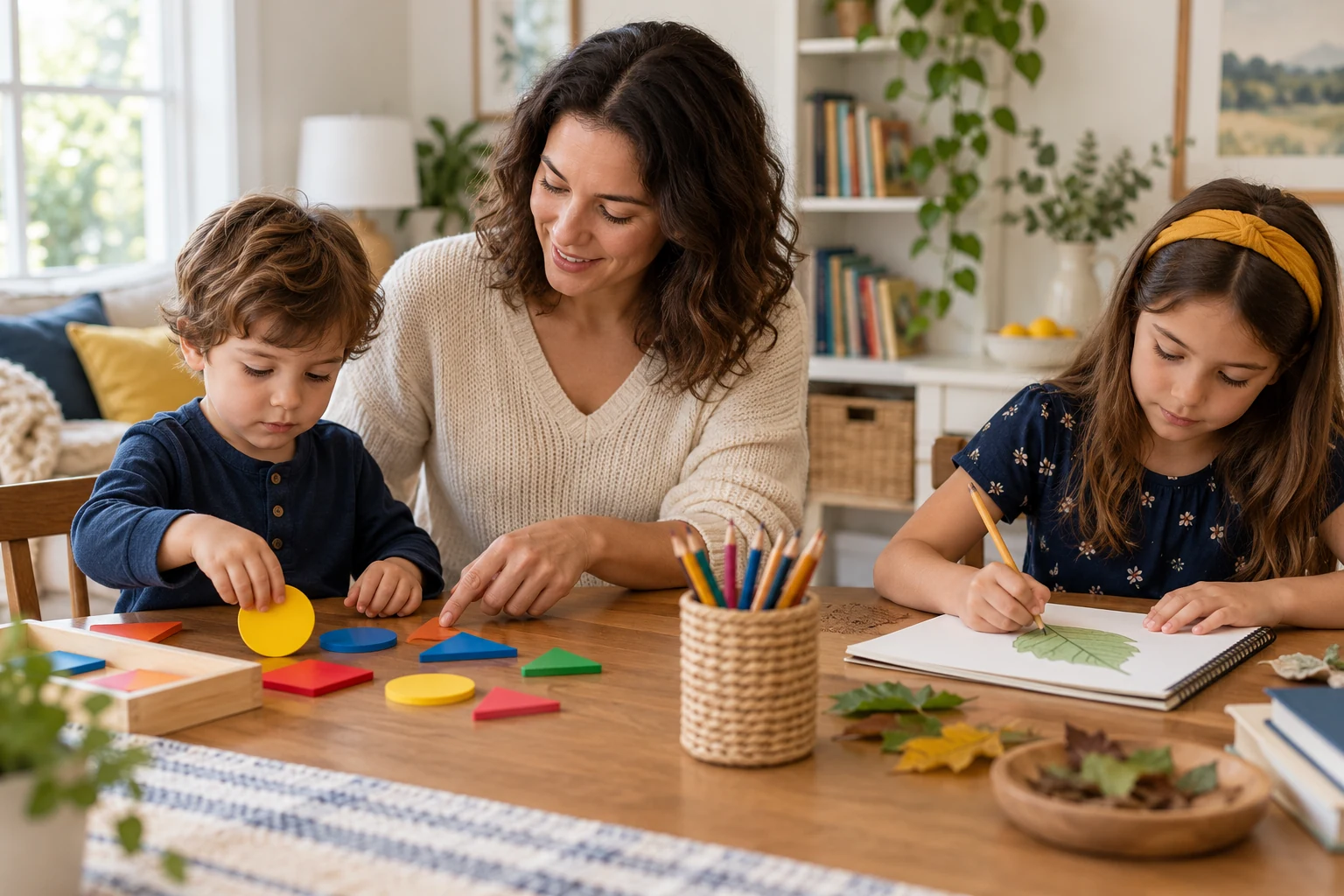
Teaching siblings together does not mean giving them identical work. A shared topic can bring everyone to the same table while each child has a task that fits their current skills.
This approach works best for selected activities, such as a read-aloud, nature observation, art project, or simple investigation. Children may still need individual teaching for reading, mathematics, and other skills. The aim is to make some parts of the day easier to share.
Begin with one common experience
Choose something both children can explore directly. A large fallen leaf, a picture book, a bowl of floating objects, or a collection of cardboard shapes gives everyone a concrete starting point.
Keep the introduction brief. Show the object, ask what they notice, and explain the next task. Avoid making the younger child wait through instructions intended only for an older sibling.
Example: one leaf, two tasks
For a younger child, invite sorting by color or tracing around a large leaf with help. They might point to its edges, describe its texture, or dictate one sentence about it.
For an older child, offer a careful drawing with labels, a comparison of two leaves, or a short written description. They could measure length and explain how the leaves are similar and different.
Both children are studying leaves, but they are not being asked to produce matching pages. The older child's work should add thought, not simply more coloring or more repetitions.
Plan who needs you first
Choose one short independent task for each child before starting. Explain it clearly and make sure the materials are available. Help the child who needs direct instruction while the other completes their familiar task nearby.
Then swap. Keep the waiting activity genuinely manageable. A new worksheet or unfamiliar craft is unlikely to stay independent just because you need it to.
With a much younger sibling, an appropriate toy or supervised nearby play may be the realistic option. Avoid making the older child responsible for teaching or watching the younger child during their own learning time.
Give each child their own materials
Two crayons, two work spaces, and separate paper can prevent avoidable disagreements. Shared materials are useful for some games, but every lesson does not have to become a turn-taking challenge.
If there is one interesting object, establish a short viewing turn and provide another task while someone waits. For activities with small parts, choose materials safe for the youngest child who can reach the table.
Finish with a shared conversation
Invite each child to show one thing they made or noticed. A younger child can point or demonstrate. An older child can explain a comparison or ask a new question.
Do not compare speed, handwriting, or how much work was completed. Comment on each child's choices: “You noticed the jagged edge,” or “You checked the measurement again.”
Know when to separate the tasks
If one child needs quiet instruction or the skill gap is too wide, use separate sessions. A shared topic is a tool, not an obligation. One successful group activity in a day may be enough.
For your next attempt, choose a familiar topic and prepare just one task per child. Keep the common experience simple, then allow the depth and form of the work to differ.