
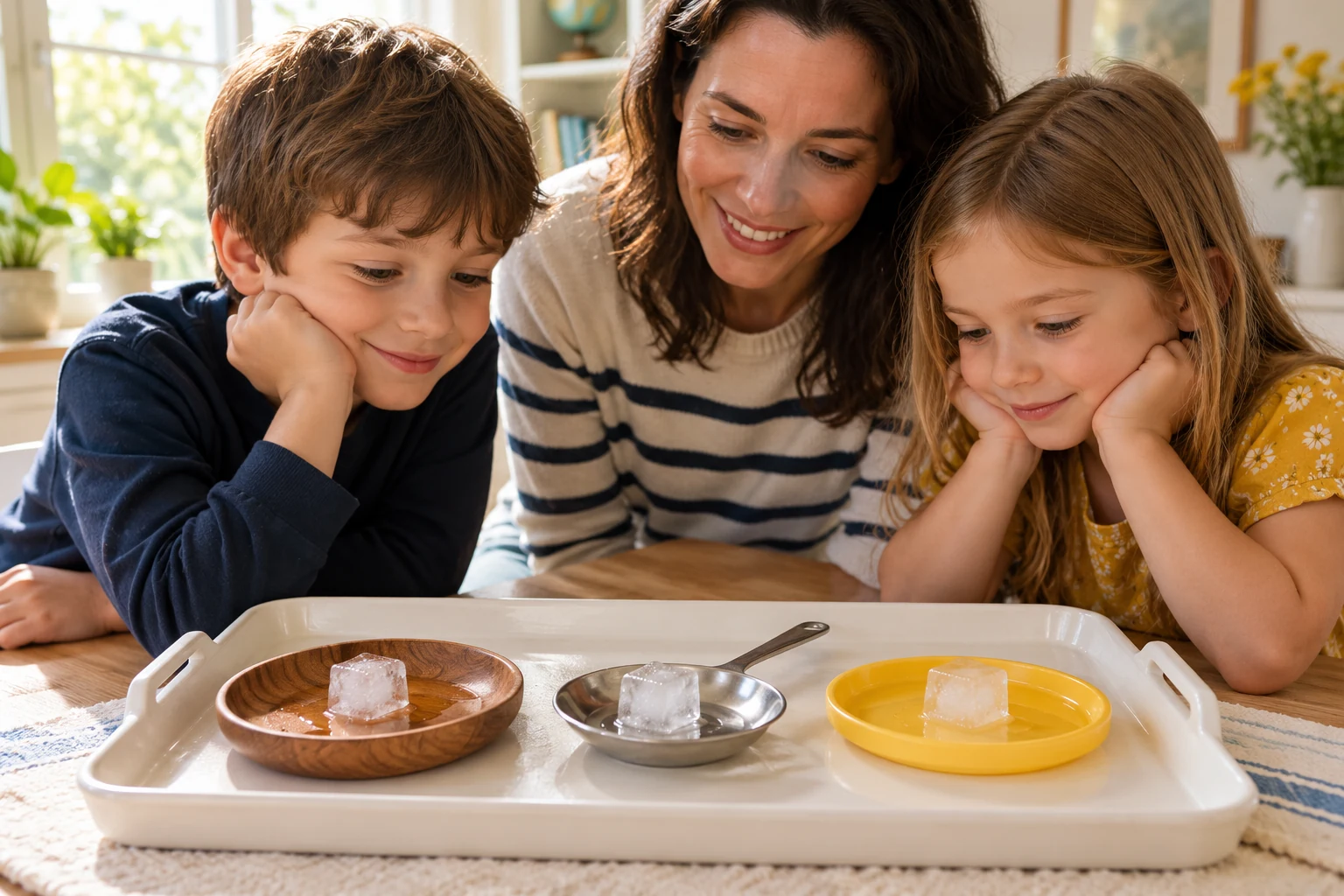
A piece of metal can feel cooler than wood even when both have been sitting in the same room. Does that mean ice will melt more slowly on metal? This investigation gives your child a way to compare the idea with what actually happens.
No hot water or heating appliance is needed. Use room-temperature materials and a tray to catch the meltwater.
What to gather
Prepare three similar ice cubes from the same tray, a flat metal surface, a flat wooden surface, and a flat plastic surface. Choose clean, water-safe pieces that are each larger than an ice cube. Add a timer and paper for notes.
Avoid sharp metal edges and surfaces that water could damage. Keep the ice out of mouths and wipe spills promptly. An adult should handle the setup.
Run the comparison
Leave the materials together in the room beforehand so none has just come from a hot or cold place. Put the surfaces on a tray away from direct sun.
Place one cube on each surface at roughly the same time. Predict which will disappear first. Check at regular intervals and record what you see without touching or moving the cubes.
Explain the science
Heat moves from warmer surroundings into the colder ice. Metal often transfers heat more readily than plastic or wood, so ice may melt faster on it even though it feels cooler to your hand. The Institute of Physics demonstrates this comparison. The Exploratorium explains why materials can feel different at the same temperature.
Look beyond the winner
Ask your child to describe a change before naming which cube is ahead. Has a corner rounded? Is the cube smaller? Has it slid into a puddle? Those details give the observation more substance than repeatedly asking whether it has finished.
An older child could draw each cube at the start and at two later times. A younger child might point while you write a sentence. Use the same observation moments for all three surfaces.
Be honest about the comparison
Household materials rarely match perfectly. Thickness, contact area, surface shape, and the amount of material can also affect the outcome. Comparing a large metal tray with a tiny plastic lid does not isolate material alone.
Call this an exploratory comparison. If your child wants a more careful investigation, find surfaces with more similar dimensions and repeat the test with new matching cubes. Keep the room position and starting conditions as consistent as you can.
If the result is unexpected
Check whether one cube started smaller, one surface was in sunlight, or one cube had much less contact with its surface. Do not replace the actual observation with the result you expected to see.
You can say, “Our setup gave us this result. What should we keep the same next time?” That keeps the focus on testing ideas rather than producing a perfect demonstration.
Close with one useful distinction
Ask whether “feels colder” and “melts ice more slowly” turned out to mean the same thing. Your child does not need a technical definition of heat transfer to begin noticing that touch alone can be misleading. Empty the tray, dry the materials, and keep the drawings for a future comparison.