
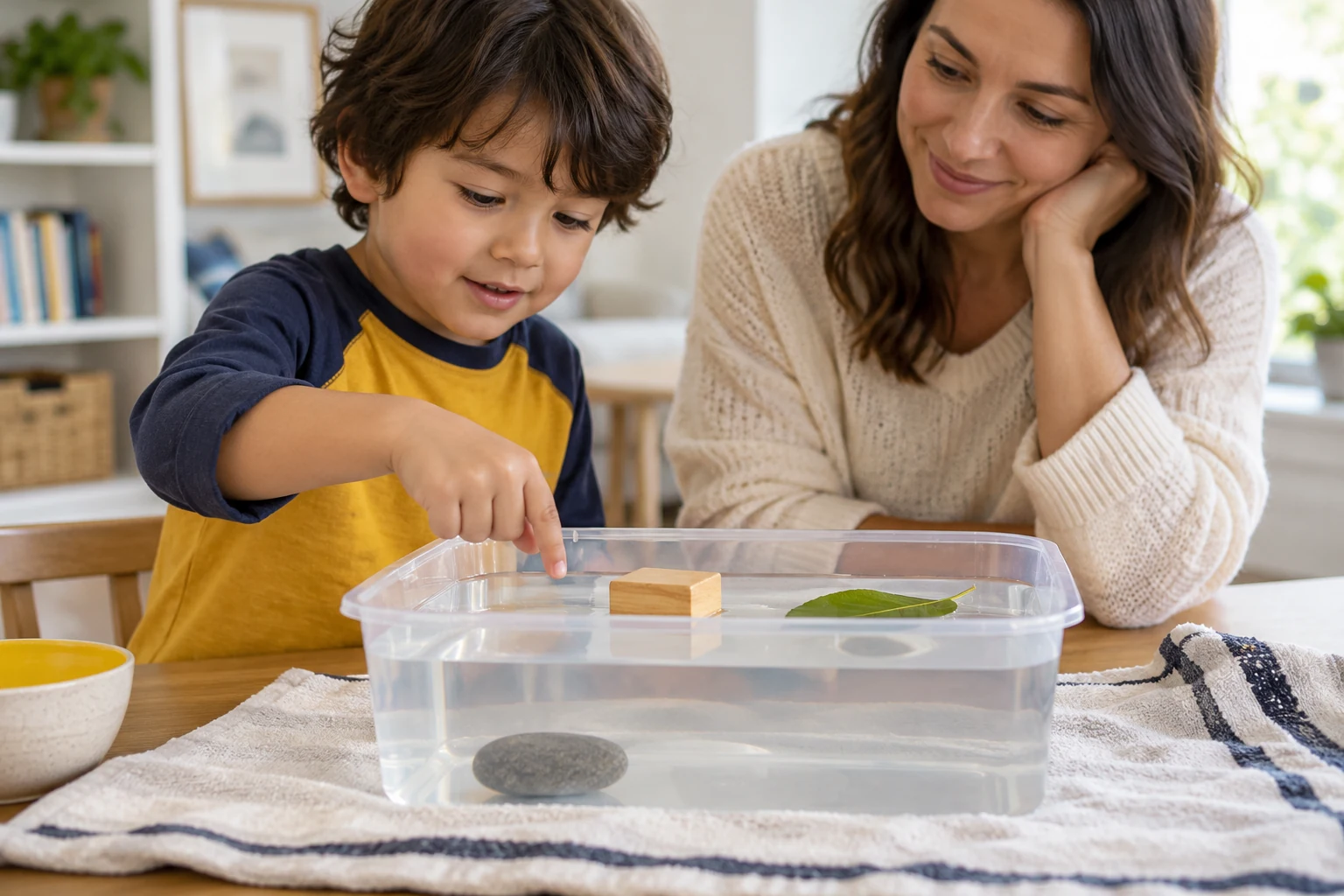
Will a wooden block float? What about a smooth stone that looks smaller? A sink-or-float investigation starts with a familiar question and gives your child an immediate way to check a prediction.
Use only a few objects for the first session. Testing four carefully chosen items and talking about the results can be more useful than dropping a whole toy basket into the water.
Prepare the materials
Choose a shallow container, a towel, water, and four to six large waterproof objects. A wooden block, clean leaf, solid metal spoon, and large smooth stone offer useful contrasts. Avoid batteries, electrical toys, sharp objects, and anything small enough to be a choking hazard.
Stay within reach throughout water play and empty the container afterward. Place it somewhere stable, away from electrical equipment and the edge of a table.
Predict, then test
Show one object and ask what your child thinks it will do. Accept the prediction without confirming it. Gently place the object in the water rather than throwing or pushing it down.
Watch where it settles. Remove it before the next test if it would obscure the view. Draw the result in a “floated” or “sank” space, adding a separate note for anything that changes over time.
A simple science explanation
Weight alone does not decide whether something floats. An object's average density compared with the liquid matters, and hollow shapes can include air in their overall volume. Water also pushes upward on objects. Science World explains sinking and floating through density and buoyancy.
Ask about the reason behind a guess
Your child may say a stone will float because it is small. Write down the idea, then compare it with the observation. You can say, “This small stone sank. What else could we look at?” rather than announcing that the guess was wrong.
A prediction is useful because it gives you something to check. It is not a score. Make your own prediction occasionally and show that you can change your mind after watching.
Notice details that complicate the result
A leaf may float initially and behave differently after becoming wet. An object can briefly trap air. The way something is placed can also affect what you see. These are good reasons to repeat an observation carefully.
Avoid making rules such as “all plastic floats” or “small things float.” Your collection cannot establish a rule about every object made from the same material. Describe the tested item specifically.
Make the recording age-appropriate
A younger child can point to a floating or sinking picture while you record. An older child can make a table with the object, prediction, result, and a short note. Keep the drawing or writing brief enough that it does not interrupt every test.
Finish with a new question
Invite your child to select one safe object for a repeat test. They might want to change its position or compare a different shape made from similar material. Save shape-changing investigations for a separate round so the original results remain easy to understand.
Before packing away, ask which result surprised them. That conversation often provides a better starting point for the next activity than simply finding more objects to drop into the tub.