
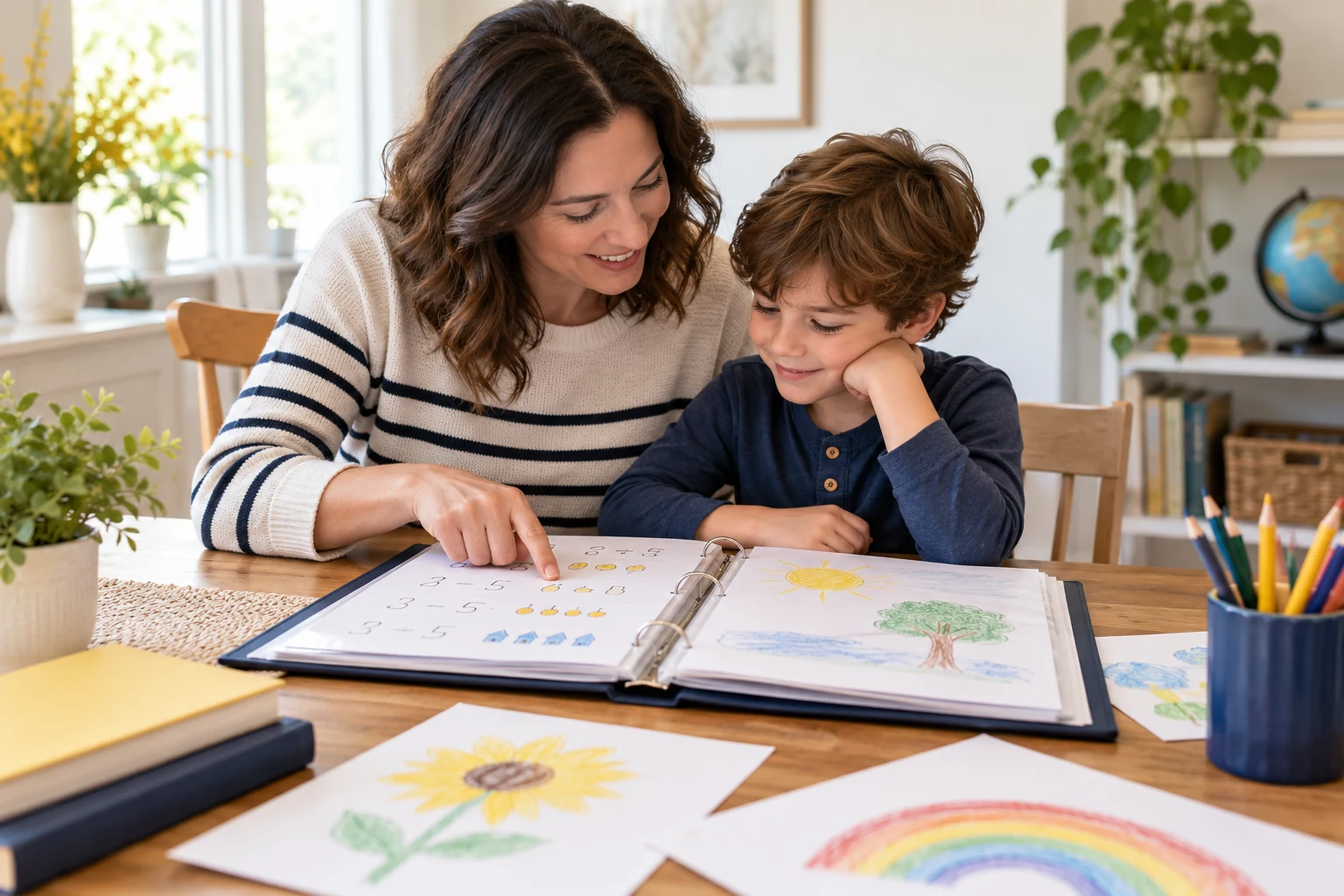
A homeschool portfolio can help you see work that is easy to forget: an early drawing, a story your child dictated, or the first time they explained how they solved a problem. It becomes more useful when you choose examples deliberately instead of saving every page.
This guide describes a practical family learning portfolio. Official reporting requirements vary, so use the relevant education authority's current instructions for any records you are required to keep.
Choose a format you will maintain
A binder, a paper folder, or a clearly organized digital folder can work. Choose one main system rather than scattering records across several apps, boxes, and notebooks.
For paper, use a few broad sections such as reading and writing, mathematics, projects, and observations. For digital records, use consistent filenames with a date and short description. Keep a backup of files you would not want to lose.
Save evidence of thinking
Useful examples include a drawing with the child's explanation, a short writing sample, a photo of a model, or a note about a conversation. A photograph alone may not explain what the child did, so add a sentence about their role.
For example: “Built a bridge from folded paper, then widened the supports to see what changed.” That note is more informative than “STEM activity” and does not claim a skill the child has not demonstrated.
Date the work and add context
Record when the work happened, the task, and any help provided. If you wrote down your child's words, label the work as dictated. If the task was copied from a model, say so.
These details make comparisons more honest. Independent writing and a carefully copied sentence show different things, even when both pages look neat.
Keep an occasional comparison
Choose a type of work to revisit, such as drawing a person, describing a picture, or solving a familiar kind of number problem. Save selected examples over time.
Do not expect every later sample to look better. Energy, interest, task difficulty, and support can all change the result. Use the collection to ask better questions about learning rather than to draw conclusions from one page.
Invite your child to choose
Ask, “Which piece would you like to keep, and why?” Their favorite may be different from yours. Include their explanation, even if it is simply that the story was funny or the building took several attempts.
You can keep one parent-selected example and one child-selected example from a period of work. There is no need to turn portfolio selection into another large project.
Review a little at a time
Set aside a short regular moment to file loose pages and remove duplicates. Keep bulky work only when it matters; a photo with a note may be enough for a temporary cardboard construction.
Keep children's names, photos, and learning records private unless you have a clear reason and appropriate permission to share them. A family portfolio does not need to become social media content.
Use the portfolio to plan
At the end of a topic, look for what the child can explain or do and what still needs support. Write one next step. The value is not in the thickness of the binder; it is in having clear examples that help you understand the learning and decide where to go next.